Cooperative Perception and Driving Behavior in Unprotected Left Turns
I co-authored a study of how perception uncertainty affects vehicle behavior at signalized intersections. I extracted vehicle trajectories from scenario videos and calculated surrogate safety indicators used to compare traffic conditions and perception modes.
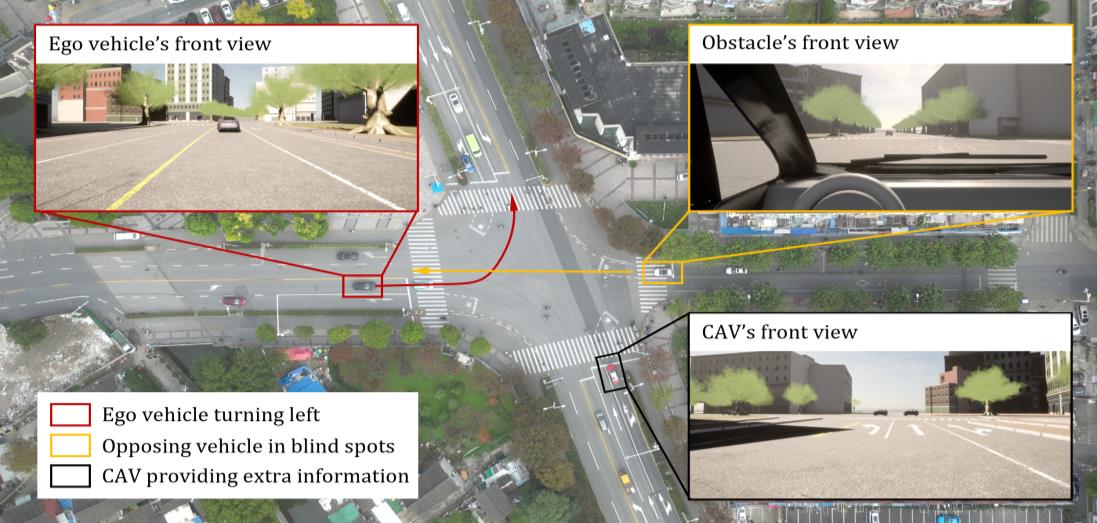
How does perception uncertainty affect a vehicle’s decisions?
During an unprotected left turn, an opposing vehicle can block the view of approaching traffic. Sharing observations from another vehicle can help, but its usefulness depends on vehicle positions, communication delay, and the perception model.
Our study examined how these conditions affect the turning vehicle’s behavior over time. We compared the observed maneuvers with a simulation reference that provides the positions of surrounding vehicles directly.
Reconstructing left-turn conflicts across 120 simulated settings.
The team used CARLA and OpenCDA to reconstruct traffic conflicts and record vehicle motion and perception outputs. Five scene parameters were varied across 120 settings.
| Scene parameter | Settings in the study |
|---|---|
| Maximum ego-vehicle speed | 25, 30, 35, 40, or 45 km/h |
| Maximum vehicle acceleration | 3 or 5 m/s² |
| Traffic volume | 500, 1,000, or 1,500 vehicles per hour per lane |
| Lighting and weather | Sunny noon or rainy night |
| Communication latency | 50 or 300 ms |
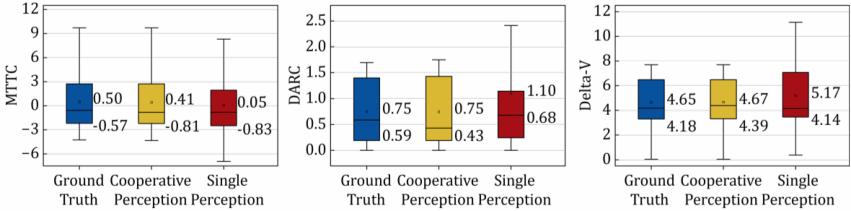
For matched settings, the study compared runs using cooperative perception with runs using ground-truth positions from the simulator. This comparison helped identify changes in vehicle motion associated with incomplete perception.
Connecting perception uncertainty with driving behavior.
The assessment combined a Bayesian model of perception uncertainty with spatial and temporal features of vehicle motion. Surrogate safety indicators included modified time-to-collision, deceleration rate to avoid a crash, and Delta-V.
The study assessed reliability within individual left-turn interactions and across scene settings. A local rule-based explanation method, LoRMIkA, was used to examine which combinations of scene parameters were associated with different reliability levels.
The results showed that reliability depends on the operating conditions, including vehicle motion limits, traffic volume, lighting, and communication delay. These findings came from simulation; testing the method with road-test data was identified as future work.
I extracted vehicle trajectories and compared surrogate safety measures.
I used Tracker to extract vehicle trajectories from unprotected-left-turn scenario videos, then calculated speed, acceleration, Modified Time-to-Collision (MTTC), and other surrogate safety indicators. I used these measures to compare safety performance across traffic scenarios and perception modes.
This paper is related to the broader scenario-adaptive cooperative perception project, which compared models across a wider set of road environments. The conference study focuses specifically on reliability in unprotected left-turn interactions.
TRB Annual Meeting, 2024.
Chen Chai, Tao Liu, Geyuan Zhang, Jiashun Xu, Songhao Lai, Jiajun Xia, and Minyue Hu.
Spatial-Temporal Reliability Assessment of Multi-vehicle Cooperative Perception in Unprotected Left-turn Scenarios at Signalized Intersection.
103rd Transportation Research Board Annual Meeting, Washington, D.C., January 7–11, 2024.
Manuscript number: TRBAM-24-04520. Figures and study details are drawn from the submitted manuscript.