Queue structures
Single- and multi-server FIFO queues, pooled or dedicated lines, finite capacity, rejection, and heterogeneous server speeds.
I developed QueueSimLab by extending a supermarket-queueing course project into a reusable MATLAB framework. It supports reproducible experiments on single queues and open queueing networks, with tools for comparing operating policies, staffing decisions, and network configurations.
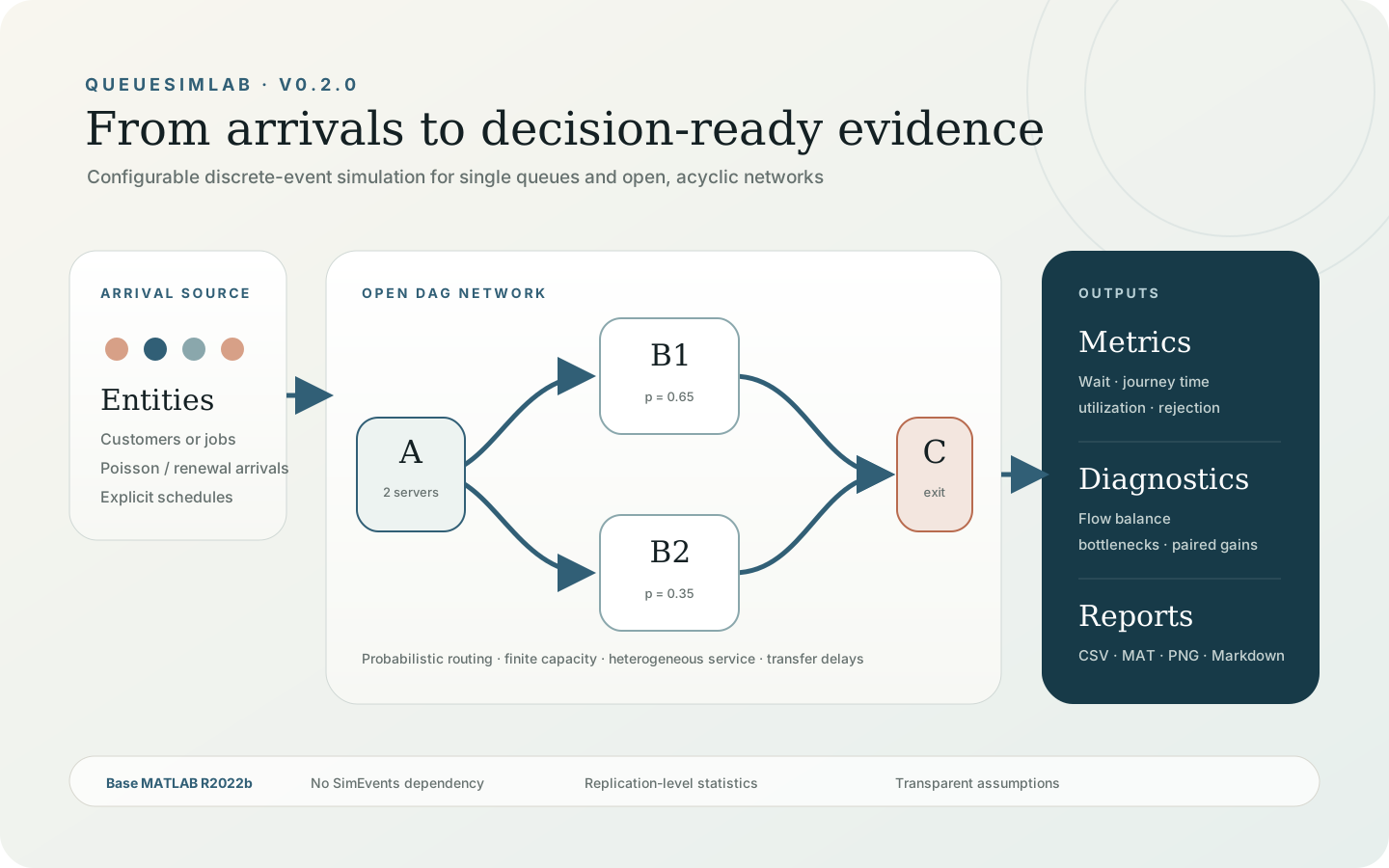
An arrival source feeds a service network. Each node can have its own service rule, number of servers, capacity, and routing behavior. The simulator records both node-level and end-to-end performance, checks flow consistency and bottlenecks, and exports reproducible tables, figures, and reports.
The project began as a course assignment about supermarket checkout lines. I wanted to move beyond a single hard-coded scenario and build a tool that could answer broader operational questions: Should customers share one line or choose among several? Where should an extra server be placed in a multi-stage service process? How does uneven routing change congestion as demand increases?
I reorganized the model around configuration objects, separate simulation engines, reusable statistics, and scripted experiments. This made it possible to change arrival processes, service rules, queue policies, network topology, and staffing without rewriting the core event logic.
I independently designed the software architecture, implemented the simulation and analysis modules, built the test suite and benchmark workflows, wrote the technical documentation, and prepared the v0.2.0 public release.
Single- and multi-server FIFO queues, pooled or dedicated lines, finite capacity, rejection, and heterogeneous server speeds.
Poisson, explicit-schedule, and supported renewal arrivals with exponential, deterministic, uniform, lognormal, or explicit service times.
Random assignment, shortest queue, and estimated-wait or workload routing for dedicated queues and network branches.
Open directed acyclic networks with probabilistic routing, fixed transfer delays, and per-node as well as end-to-end metrics.
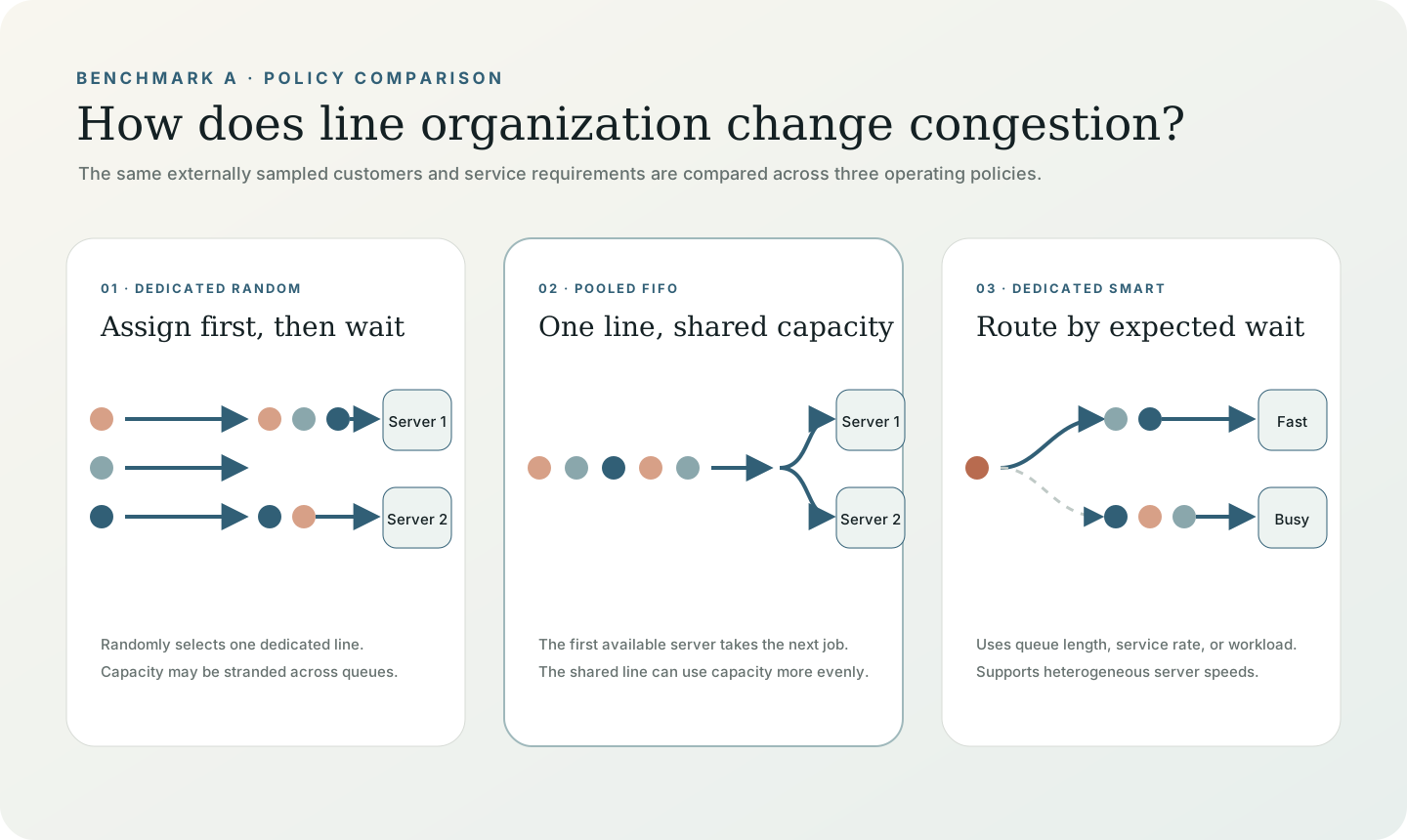
The benchmark suite separates three questions instead of combining them into one loosely controlled comparison.
| Benchmark | Decision question | Selected outputs |
|---|---|---|
| A · Queue policy | How does line organization change congestion? | Mean and P95 wait, utilization, mechanism traces, load and staffing sweeps |
| B · Network staffing | Which service stage benefits most from one extra server? | Node offered load, observed wait, flow checks, paired staffing gain |
| C · Topology × demand | How do routing concentration and demand interact? | End-to-end journey time and node-level bottleneck warnings |
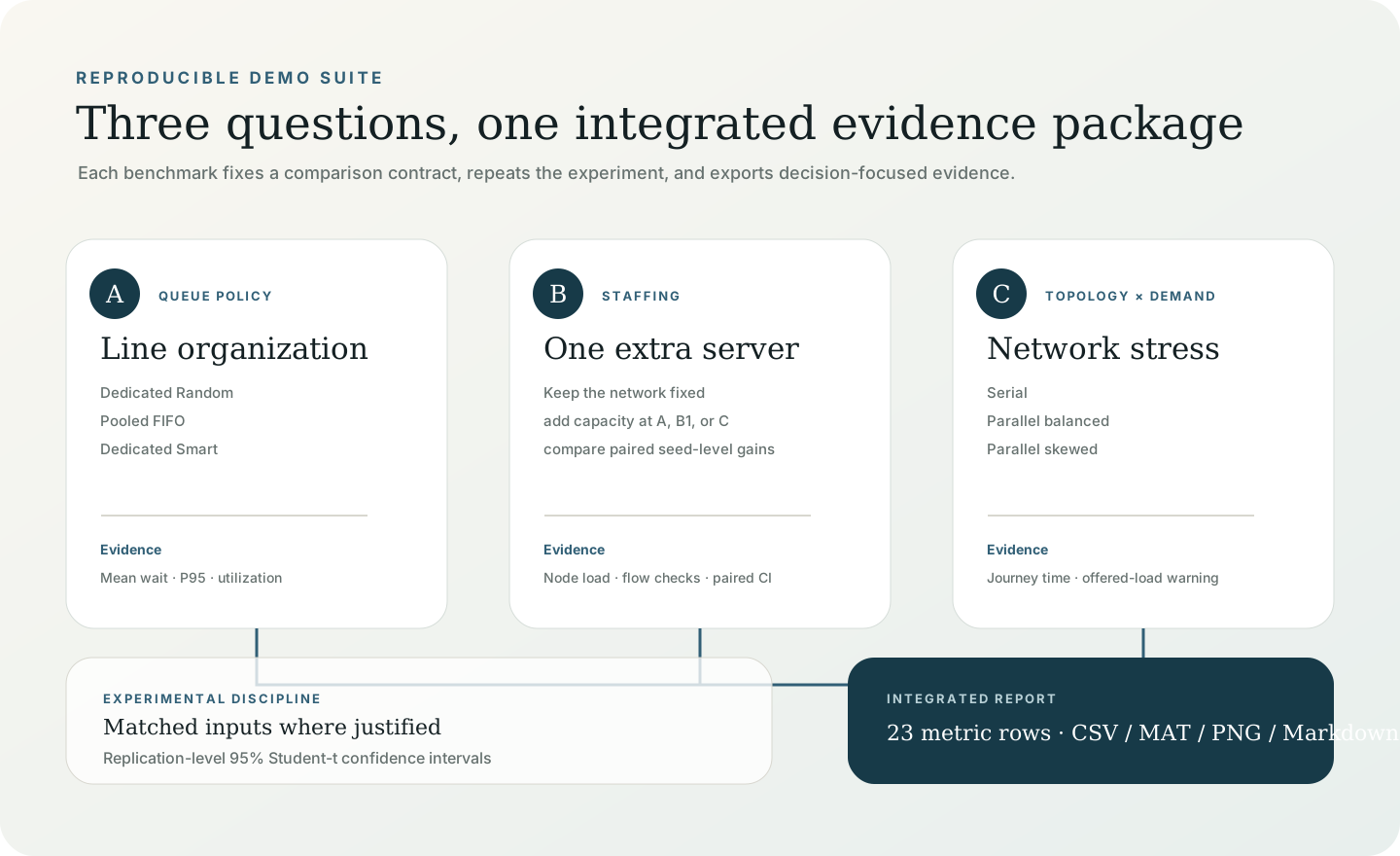
The public repository intentionally ignores runtime-generated output files. These diagrams document the released workflow; the scripts below reproduce the numerical tables and plots in MATLAB rather than presenting fabricated screenshots.
Each independent replication is treated as one experimental unit. Benchmark A reuses the same externally sampled customers and service requirements across policy scenarios. Benchmark B uses matched seeds and verifies that only the staffing decision changes. Results are summarized with replication-level 95% Student-t confidence intervals.
cfg = qsim.defaultConfig();
cfg.simulation.arrivalHorizon = 120;
cfg.simulation.observationHorizon = 120;
cfg.network.nodes.nServers = 2;
results = qsim.run(cfg);
disp(results.system);
The framework uses base MATLAB R2022b and does not require SimEvents.
The v0.2.0 release records 89 of 89 acceptance tests passing on owner-supplied MATLAB R2022b / Windows evidence. The same acceptance run verified complete Benchmarks A–C exports, including 23 integrated metric rows and six performance-workload records. Static release checks also passed on GitHub.
Core event logic, queue policies, network flow, replication statistics, diagnostics, export integrity, and benchmark contracts are included in the test and acceptance workflow.
Finite-horizon simulation outcomes are not automatically steady-state results or real-world causal estimates. Runtime measurements are descriptive rather than a fixed performance guarantee.
The private-repository MATLAB CI job was skipped because of licensing configuration; it is not reported as a successful CI run. The acceptance result above refers to the documented local MATLAB evidence.
The repository includes a quickstart, API reference, benchmark interpretation notes, validation records, a citation file, and a versioned public release.